


We all know how crucial precision is when dosing materials in production recipes, especially when you are a raw material supplier. Polyram, a leading compound manufacturer, recently established a new plant in Thailand to produce its Bondyram® solutions, a family of coupling agents. There, the tolerances between batches are particularly small.
The strategic decision to establish the plant, an investment of $5 million, was based on clear data indicating the shift of the global plastics industry’s center of gravity to Asia. The new plant meets the growing demand in the Asian packaging, recycling, and compounding markets, and significantly shortens the supply chain for local customers. With a planned production of approximately 10,000 tons per year, it was clear that every component in the production array had to meet the highest standards of accuracy, reliability, and efficiency. This is where Liad came into the picture.
The relationship between our company and Polyram is not new; Polyram had previously implemented the Spectro 4.0 PMD system. Based on this success, the decision was made to continue the collaboration between us for the weighing, mixing, and feeding systems project at the new plant – a project that posed two unique and complex challenges:
Considering all the above, we decided not to offer an off-the-shelf solution. Instead, we approached the problem by defining the specific requirements to design and build a system that would precisely meet Polyram’s needs.
We provided Polyram with three systems, each with a production output of 1500 kg/hour. Two of them feed the production lines directly, while the third is used for the dusting process of the final product. They are based on the BatchSave, originally a batch blending system, which was connected to a continuous screw feeder positioned beneath it and underwent a series of adaptations:
Due to the concern that standard sensors might provide false readings because of the materials’ tendency to stick to them, it was decided to use load cells as sensors to avoid critical errors. This allowed us to determine if the mixer had enough capacity to receive a new batch from the weighing tank, or if there was sufficient caking material in the feeding hopper.
The project required working within an extremely tight schedule of just a few months. Thanks to the fact that both companies are Israeli, the first machine was tested and approved at Polyram’s plant in Israel before being shipped to Thailand. The installation went smoothly, and the systems are already operating at full capacity as an integral part of the regular production setup at the plant.
The success of a project of this magnitude is ultimately measured on the ground. Alon Sadeh, Plant Manager at Polyram Thailand, describes the collaboration between both companies: “A team from LIADSmart came to the plant for the installation and to support the first runs, and working with them was professional and pleasant. The service was excellent, and their availability was impressive. These are technologically advanced systems of a particularly high level, with great precision in material dosing – a solution that could also be suitable for other Polyram sites.”
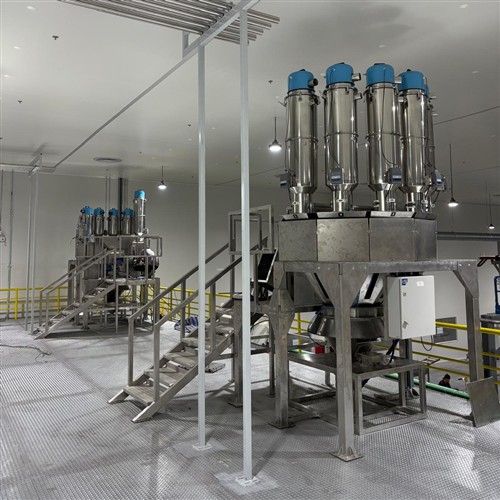 LIAD’s systems at Polyram Thailand
© Copyright Ampacet Corporation. All Rights Reserved

