


Look at the device you are holding right now. Or the medical devices saving lives in hospitals. Or the sensors in modern electric vehicles. They all have one thing in common: they are getting smaller.
The global trend of Micro-Molding is booming. Manufacturers are being asked to produce intricate parts weighing less than a single gram.
But while the parts are shrinking, a problem has emerged on the production floor. The massive injection machines and standard dosing equipment that worked perfectly for 500g parts are suddenly failing when asked to produce a 0.5g connector.
It is called “The Micro Paradox.” The smaller the part, the harder the dosing becomes. Here is the physics behind why standard equipment fails, and how we engineered a way around it.
To understand the challenge, we need to zoom in. Way in.
In a standard injection molding process, if a feeder accidentally drops 10 extra pellets of masterbatch into a large bucket production, it is statistically insignificant. The color won’t change, and the quality remains stable.
Now, imagine you are molding a tiny medical component that weighs just 2 grams.
Let’s say the recipe calls for 2% masterbatch. That means you need exactly 0.04 grams of color.
Here is the problem: A single standard pellet of masterbatch can weigh around 0.01 to 0.04 grams. This means your entire dose consists of one or two pellets.
If your feeder drops just one extra pellet by mistake, you haven’t just made a small error. You have increased the concentration by 50% to 100%. This significant overdose can change the mechanical properties of the plastic, alters the color, and in medical applications, renders the part non-compliant.
On the flip side, the consequences of under-dosing are just as severe. If your recipe calls for two pellets and a standard screw only manages to deliver one, you have instantly lost 50% of your required material.
In a micro-part, this isn’t just a slight variation in shade. It results in visible streaks, inconsistent opacity, or transparent spots. Worse yet, if you are dosing functional additives (like UV stabilizers or slip agents), missing that single pellet means the part is chemically compromised and destined to fail in the field.
Most feeders on the market today use a screw (auger) mechanism to move material. Screws are fantastic for moving volume, but they can fail at “Micro-Resolution.”
Think of a screw turning. It delivers material in “pulses” or pockets between the flights of the screw. It flows in clumps. When you are trying to dispense a total of three pellets, a screw mechanism is simply too aggressive and imprecise. It’s like trying to fill a teaspoon using a fire hose. You cannot control the flow accurately enough to stop exactly after one pellet falls.
We realized that to conquer the micro-molding market, we couldn’t just make a smaller screw. We needed a completely different law of physics.
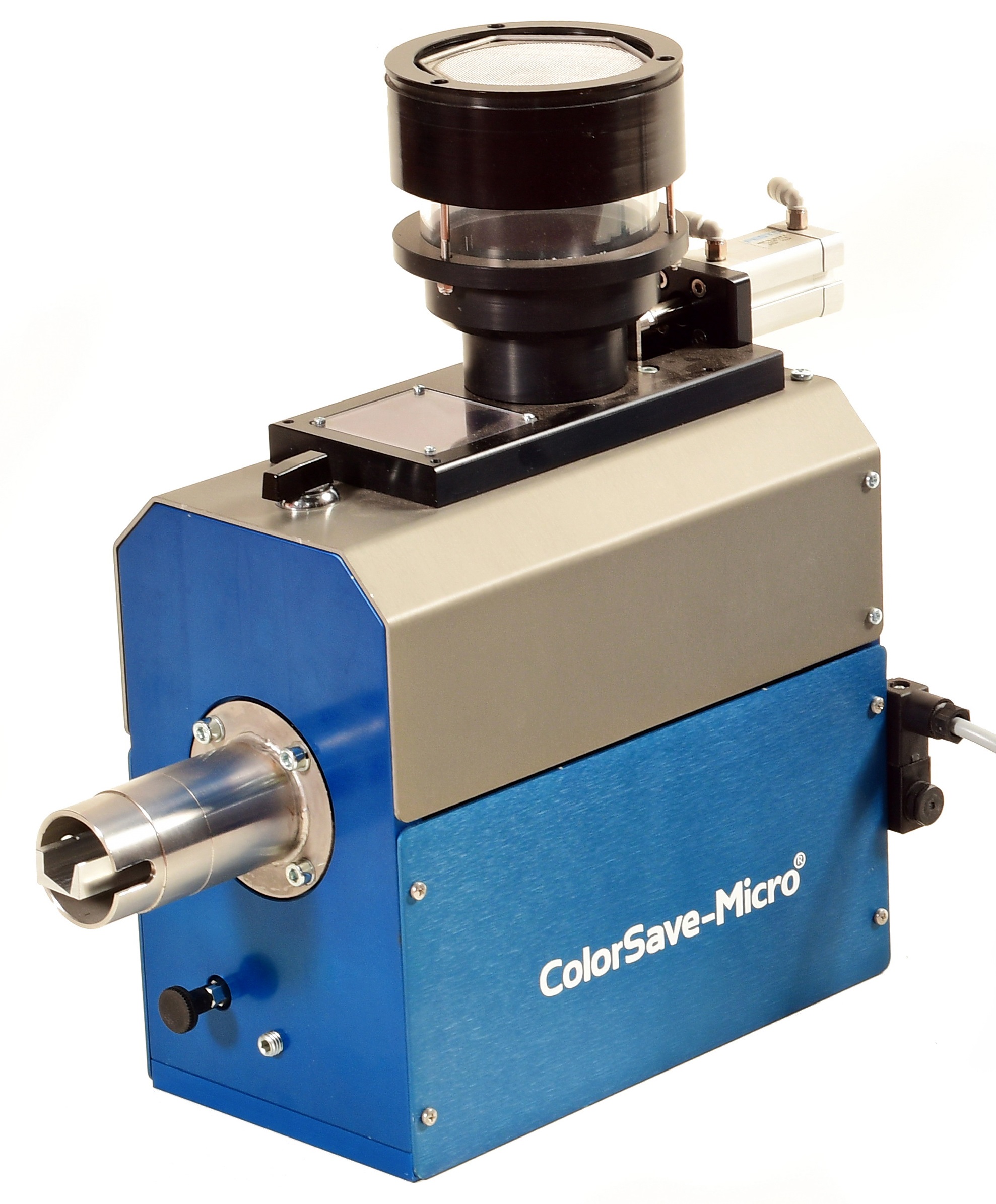
ColorSave-Micro
When we designed the ColorSave-Micro, we utilized vibration technology to move the masterbatch. Why vibration? Because it allows for Single Pellet Resolution.
Unlike a screw that pushes material in clumps, vibration “dances” the pellets forward in a uniform, single-file line. It gives our controller the ability to dispense material pellet-by-pellet and stop the flow instantly the moment the target weight is reached.
This provides an unmatched dosing range, capable of handling through puts as low as only 2-3 pellets with extreme precision.
Precision isn’t just about how you move the material; it’s about how you verify it.
In micro-molding, the constant mechanical shocks and vibrations from the injection molding machine can easily throw off sensitive scales.
To overcome this, the ColorSave Micro utilizes the same advanced noise-filtering algorithms found in our flagship ColorSave 1000. These sophisticated algorithms are designed to distinguish between the mechanical “noise” of the machine and the actual weight change in the internal hopper.
By digitally filtering out the interference, we ensure that the system “knows” exactly how much material has been dispensed, down to the milligram. It creates a robust closed-loop system that self-corrects in real-time, regardless of how much the machine vibrates.
The era of “close enough” is over. As industries like MedTech and micro-electronics continue to shrink their designs, the tolerance for error disappears.
For manufacturers, the ability to accept micro-molding contracts often hinges on whether they have the equipment to handle the precision. With the ColorSave-Micro, we have turned the hardest physics challenge in the industry into a simple, automated process.
We ensure that even the tiniest part gets the exact treatment it deserves – pellet by pellet.
Speak directly with our engineers and find ways to reduce cost, inventory and time
Request a Demo© Copyright Ampacet Corporation. All Rights Reserved

